
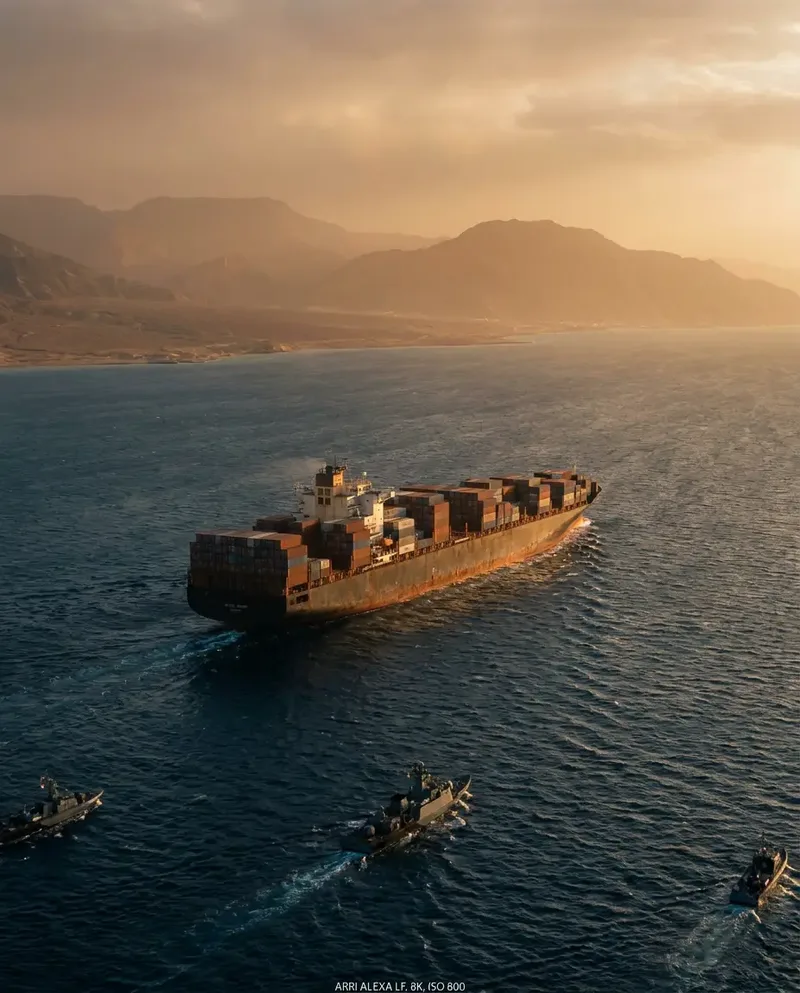
Red Sea reroutes are reshaping cargo cover
Eighteen months of Bab-el-Mandeb avoidance has turned emergency routing into a structural cost. What cargo owners need to renegotiate before the 2026 renewal cycle.
Cargo owners routing around the Cape of Good Hope to avoid the southern Red Sea need three programme changes before their 2026 renewal: benchmarked war cargo premiums instead of one-off rates-on-application, route-aware Cape transit extensions to their marine wording, and additional Loss of Hire layers to cover the 20–35% longer voyage exposure.
How did we get here?
For eighteen months, container traffic has rerouted around the Cape of Good Hope to avoid Houthi engagement zones in the southern Red Sea. What started as a tactical response to a short-term security incident has become a baseline assumption for every 2026 planning cycle.
Vessels are sailing roughly 3,500 nautical miles further per voyage. Fuel bills are up. Schedules are stretched by ten to fifteen days each way. Crew rotations and stock-throughput timing have both moved. Cargo insurance is no longer playing catch-up — it has settled into a new equilibrium that most 2023-vintage wordings never contemplated.
Are war cargo premiums still 'rates-on-application'?
Effectively, no. War cargo premiums are now benchmarked, fluid, and underwriter-specific — but the days of getting a one-off quote for an emergency Suez transit are largely gone. If you are routing through Bab-el-Mandeb, you are on a watch list and your rate is being tracked against a portfolio.
For repeat shippers, that is actually the better outcome. The right move is to negotiate a rolling war cargo facility with pre-agreed geography and clear trigger language, not to keep sending single voyage requests into the market.
What is the Cape route doing to ordinary marine wordings?
Longer voyages mean longer exposure to ordinary marine peril, more crew rotations, and stock-throughput timing problems that overshoot most policy periods. Several carriers have introduced specific 'Cape transit' extensions, and a handful of Institute Cargo Clauses (A) wordings have been quietly re-underwritten to price the additional voyage duration.
If your current policy assumes pre-2024 voyage durations, your wording is stale. That is a claims problem before it is a premium problem — an insurer can argue material change of risk if the shipment profile no longer matches the declaration on file.
Where is Loss of Hire in this picture?
Loss of Hire is the quiet beneficiary. With voyage times up 20–35%, the consequential financial exposure to a major casualty has expanded materially. We are seeing operators add LOH layers they previously self-insured, and we are recommending it as standard for anyone on liner or long-term charter economics.
The pattern from claims: hull damage that would previously have cost fifteen days off-hire now costs closer to twenty-five, because the nearest repair yard is a longer diversion. Every additional day is a real economic loss that the hull policy will not touch.
What SRMG is doing about it
We are structuring War Cargo programmes with route-aware extensions, helping operators model true voyage cost under the new geography, and brokering Cape transit endorsements that do not require renegotiation every quarter. If you are approaching a 2026 renewal with a cargo programme last reviewed in 2023, it is worth a conversation before the market hardens further.
MARKET NOTES
The water changes. We'll keep you current.
A short note when the market moves — rate shifts, wording changes, regulatory deadlines. A few times a year. No spam, unsubscribe anytime.